Saturday, September 29, 2007

Oxford American's 9th Annual Music Issue (2007)

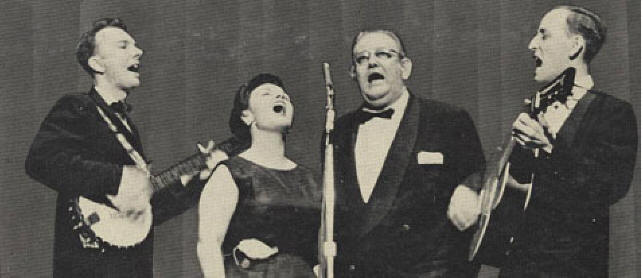
A little while ago, I tried to write something about the short stories of Lee Hays, the bass foundation of '50s folk group The Weavers and author of lyrics to songs such as "If I Had a Hammer" and "Kisses Sweeter Than Wine." That project stalled -- his stories are so simple and good and outside the normal frame of literary reference that I failed to find a language in which to write about them -- but in the meantime I've published an essay about Hays' life, radical politics, strange religion, and brilliant music in Oxford American's annual Southern music issue. My title was "Oh Yes, Oh Yes, My Darling!" but OA changed it -- without asking! -- to "The People's Singer." Oh, well. I strongly recommend going out to a store -- probably a big box bookstore, alas, since OA doesn't have a huge circulation -- and buying the magazine, which comes a CD comprised of songs by the various artists, past and present, whose stories are told therein. Almost always well-told, I think.

A particular highlight in this issue is "Hype Machine," by Bill Wasik. I've known Bill for several years now as my editor at Harper's, but like all the best editors he turns out to have been quietly developing his own voice as a writer, and, of course, it turns out to be so smart and funny and perceptive that I feel bad for having made him wade through my messes over the years. "Hype Machine," ostensibly about a band called The Annuals, is an excerpt from his forthcoming book, My Crowd, an unclassifiable work of narrative nonfiction, gag, hoax, subtle ranting, and cultural criticism.

I've yet to read the rest of the issue; UPS seems to have misplaced my copies.

In the meantime, though, I'm obliged to disclose what appears to be a misunderstanding in my account of Lee Hays. Based on various textual sources, I thought Lee was gay, that his homosexuality, closely guarded in the rural south of his youth, perhaps informed the empathy, hope, and anger so evident in his music, and that it was not controversial to say so. What I thought was the evidence was sufficiently persuasive for Oxford American's fact checkers, too. But -- I've learned I read the record incorrectly. A source close to Lee Hays while he was living (he died in 1981) called as soon as he read the story to tell me that Hays' sexual persuasion, asexual if anything, did not inform his music. This source said that my mischaracterization would have made Lee very unhappy. Doing so certainly wasn't my intention, which is why I've no hesitation in saying: I was wrong. I'm an enormous admirer of Lee's life and work. When OA sent me a list of Southern musicians to consider for the music issue, I proposed instead Lee Hays, whose name meant nothing to them. I want his name to mean a lot, to as many people as possible. That led me to scrutinize the available sources on Lee's life as closely as I could to produce a full portrait of the man. Evidently, I misread some clues.

Of course, my mistake raises all kinds of interesting questions I'm going to think about if I keep writing about musicians' lives. Why did I assume sexual persuasion is relevant to the life of an artist? Can it be irrelevant? How does a biographer determine when it is, when it isn't, and when the evidence is too thin to decide?

That said, this time I got it wrong. I hope the rest of the essay goes some distance to redeem my mistake by inspiring a few readers to go straight to the best source, the wonderful music of Lee Hays. The best record to start with, I think, is The Weavers at Carnegie Hall, a live recording of their 1955 comeback concert after the anti-communist blacklist had nearly destroyed their musical careers.

Tuesday, September 25, 2007

Alexander Cockburn, The Golden Age Is In Us(1996); George Eliot, Middlemarch (1871)

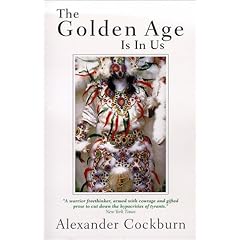
I fell asleep last night drawn down by Tarik O’Regan’s Voices, recent choral works which were sufficiently startling to delay sleep by an hour, and Alexander Cockburn’s The Golden Age Is In Us, which I’ve no intention of ever completing, or ever fully abandoning. I find Cockburn’s diary -- essays in short form, off-hand analysis, quick attacks, clear-eyed reads -- strangely soothing. The entries cover the late 80s and early 90s. I remember some of it, Nancy’s drug campaign, Arafat on the White House lawn; and have since learned about other events chronicled therein (SDI, Satanic panic), and know almost nothing about tiny liberation movements in Hawai'i, or, for that matter, in the broccoli fields of Watsonville, California. This last is of extra interest due to the gravity of narcissism -- Julie and I recently drove past Watsonville, thus endowing the little town with our vast worldly importance.

Cockburn’s point is that Watsonville is plenty stocked with worldly importance already. Here he’s writing about Frank Bardacke, a long-time radical writer residing there. Bardacke’s been on my mind, though the most I’ve read of him are his letters to Cockburn reproduced in Golden Age. But JoAnn W. tells me she is editing his giant manuscript on the UFW and that Bardacke spent ten years on this, and knows it as well as anyone in the world.

Cockburn is writing about Bardacke at the beginning of that project, I'm guessing, flush with the power of perception, detecting in Watsonville’s dusty streets, steeple-less church, seemingly blank broccoli fields all the forces of political economy, empire building, international commerce, money, sex, death, etc. Bardacke is apparently not interested in some Winesburgian distillation – he works in sweep and scope, inverting the cliché “All politics are local”: the local is the political, at the farthest reaches of the latter word’s definition.

Which brings me to the spark for this entry: One page of Middlemarch, read while brushing my teeth. Rosamond is pressing her father, Mayor Vincy, to allow her to marry Dr. Lydgate. Vincy has turned against his earlier generous spirit. “I hope he knows I shan’t give anything – with this disappointment about Fred, and Parliament going to be dissolved, and machine-breaking everywhere, and an election coming on –” “Dear papa! what can that have to do with my marriage?” “A pretty deal to do with it!”

Indeed. It’s no discovery that Eliot’s “pastoral study” is large in scope, but this first mention of “machine-breaking” -- workers' sabotage -- underlines the novel’s interest in the relationship of economies large and small to the usual stuff of money, sex, death, etc. Eliot no more subsumes the concerns of the former than would her characters in ordinary life. And yet neither does she burden them with explanatory speeches, representative positions, and such. One of the lessons of Middlemarch is that positions -- class, political, medical, even -- are like musical tones, only of significance in their relation to other tones and only stable if a phrase were to repeat itself endlessly.

Monday, September 3, 2007

Universe, Universe, circa 1970s; Hieronymus Bosch, "Garden of Earthly Delights," 1504

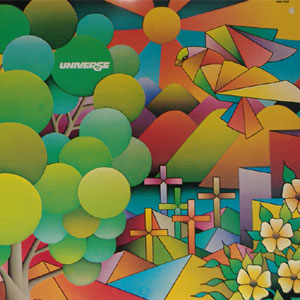
Working 24-7 through Labor Day weekend on what I pray-pray-pray will be my last article about fundamentalism ever, I take a break to drift through the internets and am rewarded with this 70s Christian rock album by a band called Universe:


Note the contrast between the musicians: While the one on the left enjoys both a cosmic halo and sartorial splendor, the guy on the right is floating in the void, looking uneasy in a shirt that is only mildly daring in this context. I can find no further information about the band, but my guess is that Cosmic Halo lives in Crestone, Colorado. As for the nervous one, look a little closer, and imagine what might have become of a fellow eager to put his freak in the closet. Trim the hair, pad the jowl, add 30 years. Could it be...


I think it is! Fundamentalist former presidential candidate Gary Bauer.

The cover is even better. It's Christian Druggachusetts!


But best of all, listen to the tunes, and imagine what America would be like today if the Jesus freaky fundamentalists of the '70s had only listened more to these guys instead of Jerry Falwell:

Friday, June 22, 2007

Unused Syllabus, 2007

I've been teaching narrative nonfiction to grad students in NYU's Department of Journalism for 2 1/2 years, and it finally paid off: not one tenure-track job offer, but two, one of them here at NYU. Decent pay for nine months of work, very interesting colleagues, lifetime job security -- of course, I turned both jobs down. I'm going to write full-time. There are books to write, I hope. One of the things I'll miss about teaching, though, is writing syllabi. It's like making a mix tape -- pick your favorite writers and hit shuffle. Here are a few that ended up on more syllabi than not:

Garry Wills' Nixon Agonistes; Roy Mottahedeh's Mantle of the Prophet; Janet Malcolm's The Journalist and the Murderer; various essays by JoAnn Wypijewski, Jack Hitt, Ellen Willis, Michael Lesy. I discovered that Dennis Covington's Salvation on Sand Mountain, a flawed but compelling book, is a great teaching text, while James Agee's Let Us Now Praise Famous Men, a flawed but absolutely genius book, is a bomb in the classroom. I tried teaching novels to journalists -- James Baldwin's Go Tell It On The Mountain, Tomas Eloy Martinez' Santa Evita -- with mixed results. Tony Kushner's fantasia Angels in America, though, ends up making perfect sense. Three anthropologists proved so effective that I taught them over and over: Susan Friend Harding's The Book of Jerry Falwell, the best book about fundamentalism I know of; Barbara Myerhoff's Number Our Days, a book that redeems the word "schmaltz"; and Michael Taussig's trippy Colonialism, Shamanism, and the Wild Man, a text closer to the heart of darkness than Joseph Conrad.

For the coming semester, I made up a recommended extra reading list. Nothing but a procrastination, which is why I'll post it on this blog instead of giving it to the students who I now won't be teaching:

***

Here are some names every literary journalist should know: Agee, Mitchell, Didion, Orwell, Mailer, etc. Following are some texts that won’t show up on many syllabi of literary journalism. And yet I found them coming up in conversations with other journalists over the years. Consider these titles the ghost canon of our mutant genre.

Herman Melville, Moby-Dick. Yes, the whale. The hack cliché about this book is that it’s a great adventure story if you skip the whale description chapters. That may be true; but if you read them, it’s one long meditation on the problem of documentation, which is to say, the problem of writing some kind of truth. There’s a Harper’s editor who tells his writers to approach every story as if they’re going to write the Moby-Dick of their given subject. One really did – an epic, brilliant meditation on rubber duckies called "Moby Duck."

Wim Wenders, Wings of Desire. It’s a movie about angels who fly around Berlin taking notes on the life of the city, gathering not news but small revelations of character and perception. Nice work if you can get it.

Jorge Luis Borges, Collected Fictions. Borges was a fiction writer, poet, and essayist whose name has become a touchstone for many literary journalists. His stories are lots of fun to read – so much so that that you might go too fast and forget to think about the subtle arguments about narrative contained within them. Consider the most fantastical of his stories as nonfiction, and imagine how they were researched and reported.

Jane Kramer, The Last Cowboy. Kramer, a working New Yorker writer, is hardly an unknown, but much of her best work is unjustly out of print. You could start anywhere – with Unsettling Europe, or What is Art?, but this one may be the most useful to the young writer, a near-perfect book-length profile in the third person.

Rosemary Mahoney, Whoredom in Kimmage. Journalist walks into a bar is the basic set-up not of a joke but of half the hack would-be workingman’s poets in literature. More often than not, it’s no more than the first step into soggy sentimentalism, but Mahoney, who set off to write a book about Irish women, perfects the form amongst a pub full of brilliant bullshit artists in the Irish countryside. (Here's a link to Rosemary Mahoney's place in a peculiar little experiment called a literature map. Nick Hornby, Alex Garland -- looks like she's in a bad neighborhood. This book, at least, deserves better; maybe this list is a step in the right direction.)

Melissa Faye Greene, Praying for Sheetrock. This probably does show up on a lot of syllabi, but not mine, and I don’t want you to miss it. It’s gripping, as they say, technically true crime but truly literature in every sense of the word, worth studying for Greene’s full, third person reconstruction of incidents she wasn’t present for.

John Dos Passos, USA trilogy. One of the great modernist documentary experiments of the early 20th century, fiction that inspired much of the “new journalism” of the’ 60s.

Studs Terkel, Hard Times. The gold standard for oral history, Terkel has probably inspired more awful imitators than any writer alive. Don’t be one of them. Read his oral histories closely and figure out how they’re structured – Terkel doesn’t just turn on a tape recorder and walk away. (Here's a great Terkel site w/ excerpts from his Chicago radio program.)

Matthew Josephson, The Robber Barons. An early 20th century example of muckraking as scripture. Like many of his contemporaries, Josephson wanted to write about the bastards who’d ripped off a nation; but unlike less imaginative writers, he fell in love with his subjects, and the result is this Dante-eque tour of the history of American greed by a writer who knows that Hell is more interesting than Heaven.

Barbara Kopple, Harlan County, USA. Why this documentary more than others? Because Kopple resolves a problem literary journalists often face, that of narrating a conflict within a community. The conventional method is to pick a character, maybe two; Kopple gets that the crowd is the character.

Wallace Shawn, My Dinner With Andre. May all your sit-down interviews be this engrossing.

Spalding Gray, Swimming to Cambodia. As good as My Dinner With Andre, but there’s only one man talking. Journalists have a lot to earn from the art of the monologue.

Charles Bowden, Blues for Cannibals. I used to assign this, but it infuriated 2/3 of every semester’s class. It’s hard going, dense, circular, often overwrought, in need of editing, and absolutely brilliant. Makes the phrase “dark lyricism” meaningful. Sort of like James Agee’s best work; study it, but beware of trying it at home.

Don DeLillo, Libra. “Every plot is a conspiracy of armed men,” writes DeLillo in this novel that uses an assassination as an excuse for a meditation on narrative structure and the construction of truths. Historical fiction shouldn’t be confused with history, but literary journalists will do well to read the best of the genre for insight into how facts shape stories.

Joe Sacco, Safe Area: Gorazde and Palestine. Sacco is one of the best narrative journalists working today, which is saying something given that he draws all his stories.

Thomas Lynch, The Undertaking. Learn how to write essays and bury people at the same time, from a poet who runs a funeral home. Build a collection of collections by contemporary essayists like Lynch, Annie Dillard, Judith Moore, Vivian Gornick, etc. Practitioners of the “reported essay” ought to study the pure form.

Saturday, June 9, 2007

James Marsh, The King, 2006; Edward Norton, Down in the Valley, 2006

Down in the Valley stars Edward Norton as Harlan, folksy innocent roiling with secret malice -- the same kind of role that made Norton famous 11 years ago in Primal Fear -- and Evan Rachel Wood as Tobe, a teenage girl that the older Harlan, a wannabe cowboy, falls in love with, seduces, stalks, shoots, and flees from. Norton can almost carry the movie with his Jimmy Stewart charm, made all the more effective by our knowledge that menace lies ahead, but the plot was that of a clever 17-year-old's imagination. That's better than the plots conceived of by stupid adults, but Valley is still a pale imitation of James Marsh’s The King, starring William Hurt as Pastor David Sandow, a Texas exurban preacher, and Gael Bernal as his bastard son, Elvis Valderaz, returned to haunt the father he never knew. I make the comparison because James’ wife, Anne-Mette, told me that Down in the Valley, released shortly after The King, drove the latter film out of theaters. Apparently, there isn't room in this town for two independent films about angry youths with patricide on the mind. In both movies, a strangely blank prodigal son sets up shop in a fleabag motel and then seduces a too-young girl. In both cases, the seduction is meant to hurt the prodigal son's father, not the girl. Both movies result in surprisingly extreme violence.

And for whatever it’s worth, both movies feature a white horse. In The King, the white horse is, I think, a subconscious echo of Michael Lesy’s 1973 book Wisconsin Death Trip -- a movie of which Marsh also made -- and thus a more evocative but less easily translatable symbol. In Valley, the white horse on which Harlan rides is plain ol’ inverted irony. Beware a man in the modern age who rides a white horse, for he is surely wicked.

Valley is a pastiche of such symbolism, so leaden that it dishonors the sources to which it alludes. Norton quickdraws in the mirror, a la De Niro in Taxi Driver (Bernal practices rifle drill in the mirror, but he has an audience in his girl, and so the scene becomes something new), and teaches a wan little boy spunk by kidnapping him, a la Kevin Costner’s superior A Perfect World. Yes -- Down in the Valley makes a Kevin Costner movie look smart. In the end, David Morse, as the girl’s father, hunts Norton down, gets shot, keeps coming, and kills the son-of-a-bitch, a la every Charles Bronson movie ever made. Morse even wears black. Get it? He wears black, but he's the good guy. Father really does know best. That’s the message.

It’s the father who gets it in the end of The King -- even though he’s accepted his bastard son, confessed to his church, and, really, been everything a Christian preacher is supposed to be. But violence still visits him, and despite his repentance, he is no more innocent of the violence than the bastard son who perpetrates it. Norton’s character becomes more obvious and ridiculous as we learn his motives -- he’s secretly Jewish rebelling against his hasidic father by playing cowboy -- whereas Bernal’s character becomes more blank and yet more subtly drawn. What we thought we understood, we realize, we don’t. And we only see how wrong we are –- how hard it is to understand the past, to recognize sin, to interpret a white horse -- around the same time William Hurt does, as his life is burning down around him.

Wednesday, June 6, 2007

"Jim Webb's Never-Ending War," 2007

From my latest story in Rolling Stone: "As night settles between the two mountain ridges that rise on either side of Lebanon, Virginia, a rough little strip of a town in the state’s southwestern corner, Senator Jim Webb’s people assemble in the Russell County Courthouse. They’re coal miners and coal miners’ wives, a third of them in the camouflage strike gear of the United Mine Workers, many of them wearing ball caps declaring them veterans of Korea, Vietnam, or Iraq. A leather-skinned veteran named Eldridge tells me in a raspy whisper that he voted for Jim Webb because Webb, a novelist and historian, had gotten these people, mountain people, right in his most recent book, a bestselling history of the Scots-Irish in America called Born Fighting. 'We’ve got our own ghosts and goblins,' Eldridge says, and he thinks Webb sees them. 'He has the Second Sight.'

"He’s the third person this evening to cite the supernatural—a kind of cultural memory, maybe—as a reason for supporting Webb, a fact that doesn’t surprise Virginia’s new Democratic senator. 'My grandmother taught me my ghosts,' he tells me, his voice a low, considered rumble."

Rolling Stone doesn't post many whole stories online, but for those who want to read it -- and willing to endure a slow download -- I've posted a pdf of "Jim Webb's Never-Ending War."

Wednesday, May 16, 2007

Stephen Shore, "American Surfaces," 1969-79

Some images from Stephen Shore's "American Surfaces." I saw this exhibit yesterday, bought the book, and wish I could stare at it for a couple of days. Shore is often associated with Walker Evans, who also took deadpan portraits of ordinary places and people, and Andy Warhol, with whom Shore got his start and who evidently influenced his sense of pop and the beauty of the banal. Comparisons with Robert Frank are also made, but to less effect, I think -- Frank was a romantic, and I don't see that in Shore. He doesn't seem to be looking for hidden magic and secret symbols in the landscape, as Frank was. Rather, I think he's trying to relearn langauge. These pictures remind me of kid's ABC book. Shore's ABCs are a lot more complicated, but not mystical -- they're in the open, there for anyone who wants to look.


Wednesday, May 9, 2007

The Faith Between Us, 2007; Arcade Fire, Neon Bible, 2006; Neutral Milk Hotel, In the Aeroplane Over the Sea, 1998


This is about this year's earnest geek hipster breakthrough band, Arcade Fire, and that of 1998, Neutral Milk Hotel. I'm just an earnest geek, not a hipster, so I hadn't heard either until a forthcoming book coauthored by my friend Scott Korb inspired me to buy Arcade Fire's Neon Bible and Neutral Milk Hotel's In the Aeroplane Over the Sea. The book is The Faith Between Us, and the "Us" is Scott, an observant Catholic with Jewish tendencies, and his pal Peter Berbergal, a Jew sobered up from a drugged out mysticism. The two trade chapters of memoir about their ambivalent yet intense relationships to their respective religions. At the end of each installment, one critiques the spiritual progress of the other. It'd be Maoist, but they're kind to one another, and deservedly so -- the accuracy with which they capture earnest geekdom provides a counterpoint to their mushier spiritual questing, and the result is something smarter than ordinary memoir. Scott, for instance, imagines that a facial twitch he's afflicted by is a sign from God and takes it as cause to play the holy fool. Then the doctor tells him it's just a twitch. Some fucked up nerves. Nothing special, just something to live with. Which is to say, he isn't chosen. Berbergal, who technically is chosen, is so fried at the beginning he's imagining new religions -- scary, psychedelic, occasionally glorious truths that happen not to be true.

Both band references take place in Scott's chapters -- an epigraph from Arcade Fire and a passing mention of Neutral Milk Hotel -- but the two bands serve in my mind as stand-ins for the early religious experiments of Berbergal and the sincerity of Scott's youthful Passion. Arcade Fire is a trippy symphony of pop hooks, adolesecent beats, and the kind of orchestration typically described as "lush" and "velvety." More like plush velour. Arcade Fire is rec room wacky, which is to say, knowing in its allusions to more dangerous and difficult artists -- Nick Cave and fellow Canadian avant-pop orchestral swingers Godspeed, You Black Emperor! lurk behind Arcade's strings and dark genre camp. But they're closer in effect to Echo and the Bunnymen, with guitars by the Cure and vocals lifted from 80s U2 clones The Alarm, and even Bruce Springsteen, circa Nebraska. Which isn't bad at all, but it's a clue that things are never going to spin too far out of control with these guys. It's not that they lack the courage to push as far as Cave or Godspeed. Rather, they seem more interested in what happens when you dress pop up in strange, when you take avant-garde to the prom. Arcade Fire presents a populist freak show, a prettified death trip for the masses.

Both Arcade Fire and Neutral Milk Hotel load up their songs with God references, which is why they show up in a book of digressive spiritual questiong. But Arcade's religion, from the Neon Bible of its title (a reference to a posthumous novel by everyone's favorite bestelling crazy novelist John Kennedy Toole) to the goth vamp glory of "Ocean of Violence" is all allusion, the faith of would-be believers alienated from their nirvana by the cultural code in which they describe it. Neutral Milk Hotel's religion, meanwhile, sounds as raw as the Jesus freaking of a college kid so high on Christ that he doesn't notice that his Campus Crusade meeting has all the spiritual intensity of Kiwanis Club. The second track, for instance, "The King of Carrot Flowers, Pt. 2 & 3," opens with a slowly plunked-out seven note palindrome leading into the drawling vocal by Jeff Mangum: "I love you Jesus Christ, Jesus Christ I love you, Yes I do."

In The Aeroplane Over the Sea is said to have been inspired by a series of dreams Mangum had about a Jewish family in hiding. I believe it -- this is more grounded stuff, so to speak, than Daniel Johnston's literally insane noodling, but it's in that same family of fucked up. In Mangum's imagination, such a plaintive cry might really have belonged to Anne Frank, which is sort of dumb; but in his instrumentation, it's wall-of-sound pop, made almost reasonable by the coherence of his songs, sturdy little vessels decked out with horns and accordians in addition to the guitars and the fuzz. Listening to Johnston is a aural voyeurism. Neutral Milk Hotel -- the tightness of the band, Mangum's songwriting -- holds Mangum's crazy together, channels it toward sane. For awhile, anyway; Mangum reportedly lost it after Aeroplane, the last album the group recorded.

Neutral Milk's In The Aeroplane was re-released in 2005 with a cover blurb from Arcade Fire. Its influence is on Neon Bible is loud, but despite the fact that Arcade's perfomance is more of a shtick, deliberately derivative, it's no less provocative than that of Neutral Milk Hotel. What was weird on In the Aeroplane shows up as wit on Neon Bible.

The relationship between Scott and Berbergal with which I began this little exercise isn't so direct or simple, and I'm reluctant to push it too far lest I replicate the same cliches with which Peter Manseau, a Catholic, and I (a half-Jew) were stereotyped when we paired up to write A Heretic's Bible -- Peter the spiritual one, Jeff the smart alecky one. What's interesting about collaboration is that whatever identity you bring to the process quickly slips away from you and into the hands of your doppelganger, and vice versa. That's what happened in A Heretic's Bible, and I think that's what I see in Scott and Berbergal's book. Berbergal's the mushroom mystic, Scott's the anxious face twitcher; Scott thinks he's called by God, Berbergal sobers up; Berbergal starts a family and a heroic record collection, Scott writes family history around his tattoos.

Then there's the Catholic and Jewish stuff, which I'll leave for some later ramble. I'm not required to have a point -- this is a blog, not an essay -- nor a verdict about religious pop or pop religion, the two subjects at hand. Suffice it to say that the blurry boundaries between all parties delight me enough to speculate on origins and intentions and effects for a few hundred words. And since this is a blog, I don't need a kicker. Besides, I must get busy with a response to something Scott wrote for The Revealer, one of my day jobs.

Monday, May 7, 2007

Robert Graysmith and Zodiac, 2007; Emily Brontë, Wuthering Heights, 1847

It's my 35th birthday, which gives me occasion to think on the fact that on my 30th I had just left Ivanwald, the elite fundamentalist training house that would eventually lead me to the book I just signed off on last week. Half a decade I spent writing about fundamentalists. That's enough. Looking at the big stack of manuscript pages, I'm reminded of the tagline from the most recent movie about the San Francisco Zodiac murderer: "There's more than one way to lose your life to a killer." In the movie, that line applies most of all to the Jake Gyllenhall character, Robert Graysmith, a cartoonist for the San Francisco Chronicle whose love of puzzles leads him to attempt to solve the murders. (That's a funny phrase -- "solve a murder." Of course, no such thing can be done.) The movie suggests that Graysmith probably did figure out who the killer was, and yet there was never any resolution. Graysmith got two books out of the deal, but he lost his job and his family. The most depressing scene was that of Graysmith surrounded by boxes of papers, the apartment he'd once shared with his family wholly devoted to the attempt to reconstruct a murderer through documents.

I'm familiar with the scene. I saw Zodiac a couple of months ago, two days before I wrote the last words of Jesus Plus Nothing. I caught the late show, then I went back to work at the industrial studio I rented for the project. It's a big space -- maybe 400 square feet -- but I'd covered most of the floor and a good part of the walls with documents. At the height of the writing, I could wander these snow drifts and pluck out whatever I needed from among thousands of pages. Now, a couple of months on, the paper tide slowly receding, it all seems blank to me. The other night, Julie was looking at some index cards I had pinned to the wall and laughed out loud at a quote attributed to a late industrialist, a brute who so hated anyone left of J. Edgar Hoover that he went insane, convinced that everyone around him was a communist out to get him; even the mail, he concluded, was a socialist plot on his life. Just desserts. The quote was from a speech he gave in 1960: "We are victims of our own decencies." What a lovely, ironic line. I have no idea what I intended to use it for.

A bleaker example: By my desk, there's a stack of documents from the Reagan archives half a foot high. I read them all and tabulated and underlined them; and used none of them, a fact that caused me great distress at one point. Now, it's only the recollection of how much they cost me to obtain that stops me from throwing them away.

There is, in fact, evidence of murder in those pages, but I don't think I'll ever put the pieces together properly. Unlike the cartoonist who almost solved the Zodiac murders, I'm not much interested in puzzles. It would take a mind given to intricate imagination, indeed, to read the cipher of murder that runs through those pages. The victims, in this case, were South African; the killers were the usual suspects in that country. The accomplices were in the White House. And they got away with it.

It'd take me five more years to figure out how exactly it all went down, whether and where and to whom shipments of American guns were made, and what they were used for, and the scriptural justifications by which true believers justified their actions. But I'm done with the fundamentalists. Five years of archives and angry churches and numbingly righteous books and "purity" manuals and deliberate omissions and sanctimonious snark and -- oh, but there were people, too, people with ideas. Dangerous and cruel ideas, I think, but passionate ones, at least. It wasn't so bad to listen to them for awhile.

But I'm done. If I went on any longer with the fundamentalists, I'd end up like Robert Graysmith -- with two overlong books instead of one and an apartment full of documents and empty of life.

So I'm getting back on the Brooklyn yuppie path I veered off of five years ago. Going to some parties. Sitting on my stoop on a mellow evening. And exercising -- what I lost in sanity during the five years of making this book I gained in girth. So I'm going to the gym, and to get myself through the first painful and boring days, I decided to buy an audio book to listen to on my IPod. I went for Wuthering Heights. I've always wanted to read it, if for no other reason than that my wife loves it, as do a lot of women whose literary tastes I follow. I thought it would be like a Jane Austen book -- a little dull, to my mind, but full of finely observed details.

But what a treat Wuthering Heights is! I'm only five chapters in, but I'm much skinnier for my choice -- I ran an extra mile on the treadmill, unwilling to stop listening and shower. And already there are nightmares and devil dogs and witches and dark glances and dangerous weather and the mysterious gypsy boy who'll become Heathcliff. That is to say, Wuthering Heights contains all the melodrama I love in comic books, only more artfully rendered. Bronte's attention to landscape and architecture and furnishings easily surpasses that of the best comic book artists (I think comic books are home to some of the best landscape and cityscape writing going these days), and the narrator, Lockwood, is a figure of comic complexity, frequently declaring himself a mirror of Heathcliff's apparent misanthropy and yet hungering all the while for gossip and company. He is the writer as she wants to be and is.

Yes, he is a she, very clearly I think. Wuthering Heights is from that literary school that disdained omniscient narrators. Stories had to come from some place, and so an observer had to be positioned accordingly, and granted an almost supernatural curiousity. Thus, the vanity of Lockwood, expressed through fascination with Heathcliff in his older years. One needn't resort to queer theory to determine that the gravity between the two -- or, at least, that attraction exerted by Heathcliff upon Lockwood -- is homoerotic in the most literal sense. That is, Lockwood has no sexual desire for Heathcliff, but his obsession with the man transcends ordinary interest, and the details he is drawn to and, often as not, infuriated by, are those that might compel a woman in love with Heathcliff.

So Bronte must have been with her creation. Her love for Heathcliff is not what makes Lockwood a woman writer in drag, however, but rather the way it's expressed. I think it's brilliant -- I wish I could learn to love my subjects like Bronte loves hers.

That's why male writers not naturally gifted enough to rise above cultural conditioning on their own must make sure to read lots of women writers (and vice versa, I suppose, though that's hardly a challenge given the testosterone-drenched canon). Years ago, many of my favorite writers were women -- Virginia Woolf, Toni Morrison, Louise Erdrich, Joan Didion, Marilyn Robinson, Kate Chopin. But my half decade of fundamentalist research drew me into a masculine universe -- dry historians of religion, angry fundamentalist texts, and thousands, hundreds of thousands of documents by and about industrialists and political hacks and military hustlers. The form my obsession with my subjects took therefore adapted. I lost the nimbleness of Bronte's Lockwood alter-ego and probably became some kind of monstrous cross between Heathcliff himself, absent the romance and good looks, and his ridiculous servant, fearful sputtering Joseph. Such a persona may have served a purpose -- with no romantic heroes to be found in my story, I had to develop a determination to push some ultimately very bad men along through the historical narrative -- but I wonder how the story would have changed had I come to Wuthering Heights sooner, had I been reminded of the way some writers love their characters.

Maybe not at all -- Wuthering Heights is, in a sense, about people who've lost their lives to obsession. Heathcliff is Robert Graysmith, only he had the good sense to brood in the moors instead of producing true crime books without resolution.

Monday, April 23, 2007

Jim Webb, Lost Soldiers 2001; Marilyn Robinson, Bible study, 2004

Almost two months since my last post on "Call Me Ishmael."
During that time, I finished my book, published a trimmed-down piece of it in Rolling Stone and wrote a review that's part of my thinking for the next book. Also, the name "Ishmael" has been thrown into temporary disrepute by its appearance (as "Ismail") in red ink on Killer Cho's arm.

My reading life has been dominated by Jim Webb, the novelist-turned-senator about whom I'm writing a profile. Which means I've been immersed in national epic, historical fiction, thrillers, and history-as-destiny. The most enduring work is probably the first, Fields of Fire, but the later thrillers, more conventional in form, have their own pleasures. Here's a great pulpy line from Lost Soldiers (2001), from a scene in which Dzung, a former South Vietnamese soldier, is being coerced into committing an assassination for the communist regime: "The reality of what Manh was putting before him crept up Dzung's spine on soft little scorpion's feet, causing him to shiver."

Some might take issue with the shiver -- a cliche? -- but I think it's perfect. The art of the thriller lies in adding nuances to recognizable notes. The image of a scorpion walking up a spine does just that. The scorpion's body looks like vertebrae, a spine upon a spine Develop that picture, and you'll see that this is a subtly clever twist on the old shiver routine. The scorpion -- Dzung's government counterpart -- looks much like Dzung. Worse, from Dzung's moral perspective, the scorpion uses Dzung to control Dzung, ascending his spine like a ladder. Dzung is complicit down to his bones. Are a scorpion's feet soft? Probably not -- but they surely feel that way, given that a scorpion is as light as an insect. There are no heavy blows here: Manh doesn't beat Dzung down, he gives him a gun. That is, he makes him a scorpion.

The subject of this post isn't Lost Soldiers, however, since I'll have plenty of space in Rolling Stone to write about Webb's books. It's another thriller, another collection of familiar notes in which smart readers and writers have been finding unexpected nuances for thousands of years. The Bible, of course. As I was sorting through some old papers tonight, I find a little pocket notebook. Paging through, I realized it contained some notes I'd made in 2004, when I attended a Bible study led by one of my favorite novelists, Marilyn Robinson, author of Housekeeping and Gilead. (Here's an essay about Robinson by Chris Lehmann.)

Peter Manseau and I were in Iowa City on tour for Killing the Buddha: A Heretic's Bible, staying with our friend Laurel Snyder. Laurel told us Robinson taught a Bible study in a church basement, and after several drinks, we decided to venture out into a snow storm to find it. Our method: Peering into windows of churches. It took us about a dozen tries, but we found her. Robinson didn't seem surprised at three snow-covered strangers stomping into the middle of her class. Laurel hung back, but Peter and I pulled up chairs. "Fetch these boys some Bibles," Robinson instructed one of the bearded poets who'd become her disciple. Robinson's students were mostly writers, but she's serious about her Bible, a self-declared Calvinist and, if I recall, an ordained minister.

My notes from the evening are fairly cryptic. I'm going to write them down anyway, and then throw out this little notebook. I don't share Robinson's beliefs, but I'm fascinated by her gods.

Literature, says Robinson, proceeds by pushing toward definition. The messiah is a definition of how God will act in history. Which is to say, a counter-intuitive definition, since the messiah's action is that of literature. "The revolution that goes on continuously," says Robinson, "is a refining of definitions."

Would that it was so simple. But Robinson detects in the story impulses toward universalism and impulses away from universalism -- a literary rubber band.

Or, a "pulse." "We have broken His heart a million times over." And every time we do, God responds. "The whole Bible is God trying to say, 'I take this very seriously.'"

But we just won't listen, and we keep knocking God around. God, says Robinson, can be understood at times as like an abused wife -- an interesting idea about who holds the power in this relationship between humanity and the divine.

Then Robinson says: "What would we do without feeling like we're on the dark side of justice?" I'm not sure what she meant by that, but I wrote below it, "asked in a tone of gratitude." She follows with: "As soon as language of justice emerges, it becomes metaphysical." So perhaps this all means that we're spared the abstraction of one of the things that matters most to us -- justice -- by being on the wrong side of it. There are moments of justice in this world, she says, but not where we expect them (or create them?)

The last coherent note I made was: "Humanity will be betrayed by authority."