Showing posts with label songs. Show all posts

Saturday, September 29, 2007

Oxford American's 9th Annual Music Issue (2007)

A little while ago, I tried to write something about the short stories of Lee Hays, the bass foundation of '50s folk group The Weavers and author of lyrics to songs such as "If I Had a Hammer" and "Kisses Sweeter Than Wine." That project stalled -- his stories are so simple and good and outside the normal frame of literary reference that I failed to find a language in which to write about them -- but in the meantime I've published an essay about Hays' life, radical politics, strange religion, and brilliant music in Oxford American's annual Southern music issue. My title was "Oh Yes, Oh Yes, My Darling!" but OA changed it -- without asking! -- to "The People's Singer." Oh, well. I strongly recommend going out to a store -- probably a big box bookstore, alas, since OA doesn't have a huge circulation -- and buying the magazine, which comes a CD comprised of songs by the various artists, past and present, whose stories are told therein. Almost always well-told, I think.

A particular highlight in this issue is "Hype Machine," by Bill Wasik. I've known Bill for several years now as my editor at Harper's, but like all the best editors he turns out to have been quietly developing his own voice as a writer, and, of course, it turns out to be so smart and funny and perceptive that I feel bad for having made him wade through my messes over the years. "Hype Machine," ostensibly about a band called The Annuals, is an excerpt from his forthcoming book, My Crowd, an unclassifiable work of narrative nonfiction, gag, hoax, subtle ranting, and cultural criticism.

I've yet to read the rest of the issue; UPS seems to have misplaced my copies.

In the meantime, though, I'm obliged to disclose what appears to be a misunderstanding in my account of Lee Hays. Based on various textual sources, I thought Lee was gay, that his homosexuality, closely guarded in the rural south of his youth, perhaps informed the empathy, hope, and anger so evident in his music, and that it was not controversial to say so. What I thought was the evidence was sufficiently persuasive for Oxford American's fact checkers, too. But -- I've learned I read the record incorrectly. A source close to Lee Hays while he was living (he died in 1981) called as soon as he read the story to tell me that Hays' sexual persuasion, asexual if anything, did not inform his music. This source said that my mischaracterization would have made Lee very unhappy. Doing so certainly wasn't my intention, which is why I've no hesitation in saying: I was wrong. I'm an enormous admirer of Lee's life and work. When OA sent me a list of Southern musicians to consider for the music issue, I proposed instead Lee Hays, whose name meant nothing to them. I want his name to mean a lot, to as many people as possible. That led me to scrutinize the available sources on Lee's life as closely as I could to produce a full portrait of the man. Evidently, I misread some clues.

Of course, my mistake raises all kinds of interesting questions I'm going to think about if I keep writing about musicians' lives. Why did I assume sexual persuasion is relevant to the life of an artist? Can it be irrelevant? How does a biographer determine when it is, when it isn't, and when the evidence is too thin to decide?

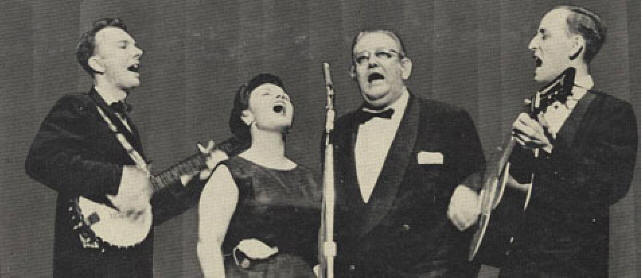
That said, this time I got it wrong. I hope the rest of the essay goes some distance to redeem my mistake by inspiring a few readers to go straight to the best source, the wonderful music of Lee Hays. The best record to start with, I think, is The Weavers at Carnegie Hall, a live recording of their 1955 comeback concert after the anti-communist blacklist had nearly destroyed their musical careers.
Monday, September 3, 2007

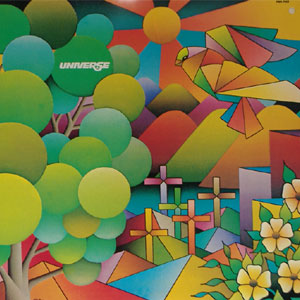
Universe, Universe, circa 1970s; Hieronymus Bosch, "Garden of Earthly Delights," 1504

Working 24-7 through Labor Day weekend on what I pray-pray-pray will be my last article about fundamentalism ever, I take a break to drift through the internets and am rewarded with this 70s Christian rock album by a band called Universe:


Note the contrast between the musicians: While the one on the left enjoys both a cosmic halo and sartorial splendor, the guy on the right is floating in the void, looking uneasy in a shirt that is only mildly daring in this context. I can find no further information about the band, but my guess is that Cosmic Halo lives in Crestone, Colorado. As for the nervous one, look a little closer, and imagine what might have become of a fellow eager to put his freak in the closet. Trim the hair, pad the jowl, add 30 years. Could it be...


I think it is! Fundamentalist former presidential candidate Gary Bauer.

The cover is even better. It's Christian Druggachusetts!


But best of all, listen to the tunes, and imagine what America would be like today if the Jesus freaky fundamentalists of the '70s had only listened more to these guys instead of Jerry Falwell:

Wednesday, January 10, 2007

Noahjohn Dittmar, "Mr. Ditty"; Grant Morrison, "Doom Patrol"; John Fahey, "The Yellow Princess"

This is what blogs are good for: As soon as I'd posted some thoughts about Werner Herzog, I got a comment. Terrific -- hardly anyone knows this blog exists. So who's it from? One of my best friends from college, Noahjohn Dittmar, who I've long since lost touch with.

Noahjohn was a wiry, hyper, brilliant, freak from Gainesville, Florida. He wrote amazing stories, about his mom, a pot dealer who gave him an allowance in weed; and the local cops, who'd shake him down for the weed; and "The Melody Club," the dyke bar his mom started taking him to when he turned 16; and his aunt, a Vegas showgirl known as "Miss Derriere" (he had pictures!). And they were all true. He'd come north for college with a contingent of Gainseville scholarship kids -- Noahjohn was poor as piss, like most of Gainesville -- who testified to their veracity. Noahjohn didn't lie, because he didn't need to. The story I remember the best was about his dad, a giant old biker-type, who led a brigade of men to kill the alligator that'd moved into the pond all the kids in the trailer park swam in. They wrestled the gator down, and then Noahjohn's dad, as I recall, plunged a knife between its eyes. Noahjohn accompanied this story with a picture of his dad, relaxing in his trailer, a big .45 inexplicably tucked into the curtain rod above him, next to his collection of ceramic theater masks. (Not the gator Noahjohn's father killed.)

Noahjohn didn't just have great material -- he had the true gift of mimicry. Some writers pay attention to dialogue and dialect, but Noahjohn breathed it. You'd come into the house and find Noahjohn dressed in a skirt and nothing else, frying up a hunk of revolting cheese, yapping a story (audiences were sometimes incidental), cackling at its developments, and channeling all the men and women who lived under the sign of Gainesville Green into sterile, waspy hills of Western Massachusetts. It was better than a movie. Whether or not Noahjohn wrote it down was almost incidental.

That -- and the reality of $ -- may explain why, after a brief stint as a reporter (during which time he attended school board meetings and went about interviewing local police in a black VW bug with an old Porsche engine sticking out of its ass and a shag carpet interior), Noahjohn decided to get his teaching certificate instead of becoming a writer. He moved back to Gainesville, and became a teacher -- from what I heard, an amazing one. But we lost touch. Every few years, a round of email, and then, nothing.

Again, this is what blogs are good for: I check out the comments to this new blog, and I find the following from Noahjohn, in response to a post about Ann Nocenti's "Daredevil" comics:

If it be devils that dare spark your penchant for subversive mayhem, try reading the Lucifer series by Mike Carey. Building on the mythos spawned by Neil Gaimman's Sandman series, the series begins with fallen angel Morningstar resigning from his job as the safegaurder of Hell. Instead he plays piano in a night club and accepts a job from God with the intention to double cross. Or check out Carey's version of John Constantine: Hell Blazer. Don't let the name mislead you. This title existed well before the cheesy American counterparts. Constantine (much like the Lucifer character) manages to save the world through arrogance and sleazy cons. He uses he best friend's child to lure demons from hell. And what magnificently hideous demons they are in pure loathing and grotesque debauchery.

Now if you are looking for some new super heros. Try Grant Morrison's run for the series DOOM PATROL (if you can find them. There from the early 90s) His characters are truly unique. One character is the persona of an entire gay district in poland that was wiped out by Nazis (truth behind this remains unsubstantiated). "Danny the street" is his name, and that is exackly what he is, the ghost of a lost street where lonely men seeking love wandered. There is also a woman with 24 personalities, each with distinct powers. In one issue, she changes into a character who attacks her fellow super heroes. And my favorite, a robotic man with a human heart and brain who strives to nurture the highest human virtues only to find out in the end that he really is robotic through and through (even his brain and heart). Any way, nice to see you reverting back into the interest in the comic form. I am obsessed with this genre and have been working on a white trash sci-fi story that no one will publish but possesses unusual potential as a spiritual commentary. ... Anyway, thought I'd say hi. Always keeping tabs on you. Noahjohn Dittmar or Mr. Ditty.

And then this, more sobering, in response to a post about Children of Men and Iraq movies:

I remember visiting my cousin-in-law in his parent's manicured house outside of Jacksonville before I moved from Florida. Agitated and manic, reaking from booze, he held up his body armor and showed me where a 16-year-old "insurgent" shot him in the chest with a machine gun. He told me he let his guard down while poltroling a quiet zone. When I asked him how he knew the "enemy" were teens, he replied "They looked like me."

A year before, we fired potatoes from a PVC pipe fuled by hairspray. We shot our taters from his parent's front porch at the St. John's River, and he discussed his decision to enlist in that simple way that highschool seniors discuss dreams as if they were reflecting on a life already lived. An almagamation of hippie, surfer, brawler, artist, and daddy's little boy, he said he had no other good plans for the future and that it would mean so much to his dad who loved God and country as much as his steak and potatoes. Daddy thought Bush was the A1 sauce or better yet, some local good-ole-boy BBQ sauce with just enough spice and woop-ass to tame the pallet.

And now, he held that bullet riddled armor, and he twirled his machine gun (ya know, the ones all the boys bring home).

That night he showed me hours of video footage he'd smuggled out. Some amateur, some done very creative and professional, moonlight productions using army editing equipment. He said he could not show them to his parents. He said his mom would cry if she knew what heros had to do.

Almost all the films featured heavy metal music. And all possessed that heavy-handed warrior luster, that Rambo sheen that only revisionist winners can wear.

These films, remarkably, rarely focused on the grotesque (though in a war with unfathomable media attention, grotesque contains many labels sort of like good salsa: Hot, Mild, Chunkey, Puree.) Most of the films showcased American fire power. Automatic grenade launchers firing like machine guns and leveling cities in several hours. Or heroic moments when my Cousin-in-law saw the errant wire above the front door of a home they were about to bombard. As white skinned men littered broken english curses, my cous stood back and RPGed the door and the entire building collapsed.

I suppose the shock and awe of these stories resonated with me in that same way you describe, Jeff. What was I doing about this!!! The one woman I loved more than the world who could actually put up with me, who escaped poverty and bad taste, and who rarely shed a single tear for anything tragic expected more from me on this front.

But coward that I am, I could only listen and tell him things like "good luck" or "I don't pray much , but I will for you." This Christmas, I just saw my cous. He wants to go back after his third tour of duty ends to sign up as a mercenary. When I first met him almost eight years ago, he was painting miniture knights for a role playing game. Damn.

We are all lying, spineless, hypocritical cowards. We cannot murder to solve this war, we cannot protest, nor write, nor scream, nor pray. So what will it be then? You assume we are bedazzaled by illusions, but shit, man, even the illusions of truth are overly accurate if only by analogy. I have only two anwsers and who knows how much either accomplishes. When hijacked, we act or die cowards (ofcourse a hero's death is a small honor to an atheist), so perhaps a little melodrama and art is needed. Perhaps illusion to fight the illusion: a war of muddled illusions where propaghanda subverts truth in the name of TRUTH. (Didn't Michael Moore do this?

I'm so full of ***. I have no anwsers except cop-outs. Art and stories, truth tellers from outside and within the shell of the counrty and the money to push them like heroin into every quiet, small, lazy town where they grow all the potatoes and raise all the cows.

One more, in response to a brief post about a John Fahey tribute album:
Thank God someone still listens to him. Listen to "Yellow Princess", a beautiful tune I recently used in a home movie on Longwood Gardens in Penn. Yvonne, (my goyle) found one of his more obscure vinyl albums. Too bad the record player don' work.
You can hear part of "Yellow Princess" here.