Saturday, June 26, 2010

Journalists & Stenographers

Since, sadly, I'm not a graduate of what Jeremy Scahill calls the "Joe Klein/David Brooks/Peggy Noonan School for Caviar Correspondents," I've only met Brooks, the special subject of Scahill's contempt for his recent NYT column declaring that the duty of journalists is to keep the secrets of their fellow members of the ruling class. (The dereliction of this duty that provoked Brooks to re-swear his allegiance to the Beltway was Michael Hastings' exposure of General McChrystal in Rolling Stone.) My brief meeting with Brooks was at a junket in Key West sponsored by a conservative think tank called the Ethics and Public Policy Center. Since EPPC had gathered its flock (besides Brooks, Christopher Hitchens, Elisabeth Bumiller, and reporters and editors from all the other usual suspects) with money from the Pew Trust, and I was also on the Pew teat at the time through the NYU Center for Religion and Media, I got an invite to "observe." That meant a chair against the wall, in which I was to sit quietly. All the better to marvel at caviar correspondents new, old, and converted -- the last of these being Christopher Hitchens, who proposed loyalty oaths for American Muslims, a position that allowed Brooks to play his favorite position: Liberal. Not that he is liberal. His specialty is in moving the spectrum so far rightward that he looks broadminded by comparison.

But "Hitch," as those who claim to know Hitchens call him (I don't) was, apparently, determined to test Brooks' liberalism. My memory is shaky here, because while I wasn't allowed to talk with the VIPs during session was I encouraged to drink, heavily, with them afterwards, but as I recall Brooks' wife was there and some journalist for some wonk magazine -- I don't remember who -- wove over to Brooks, holding forth on "respectability," or "the vital center" or some such -- to warn him that Hitchens was over by the rail of the dock with Brooks' wife, seemingly determined to seduce her or tumble into the water.

What is the point of this story beyond gossip about the mandarins? Nothing other than that it's a fine example of what Brooks says journalists shouldn't do: Tell tales about people more important than them. To be honest, I tried not to at the time; I thought this short report for my Pew-funded project was very respectful. I did say host EPPC and its leader, Michael Cromartie had created an amiable forum -- Brooks' wife, as far I know, went back to the Brooks' room, and Hitchens went back to his bottle.

But Cromartie didn't think so. Maybe that's because he plays a significant part in the archives of the Family, a group which had decided I was no good after I'd first published on them in Harper's. At the time, Cromartie told me I'd gotten it right -- that their theology was sort of a vapid, perverted Buddhism. But later he popped up in a "review" -- the sort that invites the subjects of a book to talk back -- by yet another attendee of that Key West junket, Jay Tolson. Cromartie said nasty things about my book, but that's not breaking the rules, since I'm not important in Washington. (Or anywhere, really, except maybe my apartment when my daughter wants to go to the park.) But I knew we were on the outs long before that -- I never got invited back to Key West, and he wouldn't return my phone calls. That's saying something for a man who makes his living trying to influence journalists. I'm not even worth influencing. Thank God.

But David Brooks is. "So much of what is wrong with journalism today can be gleaned from a simple RSS subscription to David Brooks's columns," writes Scahill, author of the investigative bestseller Blackwater.

In his world, those who have access to the powerful guard their darkest secrets--not their affairs or infidelities or alcohol problems [those, too, actually; journos love trading naughty tales they'll never print lest they lose access to the sources of their copy], but the kinds of views McChrystal and his aides expressed in Hastings' article, the kind of conduct they condone and order in US wars. In a responsible society, one with a vibrant and independent press, the job of journalists should be to hold those in power accountable. Part of the job of journalists is to do precisely what Hastings did--catch powerful figures in their true element, not simply portray their crafted public personas and loyally transcribe their prepared public statements. "McChrystal, like everyone else, kvetched," Brooks writes. "And having apparently missed the last 50 years of cultural history, he did so on the record, in front of a reporter."
To Brooks, Hastings's conduct was a part of the decay of the private, sacred relationship between the press and the powerful. 

Friday, June 25, 2010

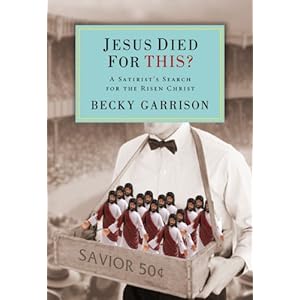
Becky Garrison, Jesus Died For This?, 2010

My friend Becky Garrison and I have been emailing about the various coalitions that have been forming or not forming around the question of evangelicalism and homophobia. Becky is a Christian satirist -- that is, a Christian who writes satire, not one who satirizes Christianity, though come to think of it she does that, too. But like most satirists she mocks because she loves, and because she loves her faith she's angry about the way it's so often abused. We have sort of an ongoing mild debate about what to do about it. Becky's keen on alliances, but I'm wary. Whenever one group or another tries to recruit me and my books for their cause I get uneasy. This morning I came up with an absurdly mixed metaphor of cliches to explain why:

To be honest I find the whole project of "common ground" to be a distraction. My first interest is the story. Second comes politics. Politically, I think there's a lot too much bridge building going on. Sometimes you need to tear shit down. Or, to put it another way, writers shouldn't be in the business of building big tents. We get on the stage and tell a story and leave it to others to decide whether they want to listen. And then those folks, if they're all standing around together, might want to build a big tent for themselves -- at which point, the writer had better skedaddle or risk getting stuck telling the same story over and over again, ever more polished, like an 80s one-hit wonder trapped in the matinee slot of a second rate Vegas casino forever.

So I tell my stories about C Street or the Anti-Homosexuality Bill in Uganda or some other problem of fundamentalism. People want to build coalitions with that information, great. People want to bust up coalitions with it, maybe even better. The myth of common ground is the lie of empire. It's also the bane of literature, since common ground can only be achieved by shaving off sharp edges and losing specificity.

Becky, fortunately, keeps the sharp edges; that's what satire is good for. Here's one of her sharpest, the fabulous cover of her new book, coming out next month:

Thursday, June 24, 2010

The Family: Panama and the Pasadena Prophecy

Another modest document from the Family archives, Collection 459 of the Billy Graham Center Archives at Wheaton College, in Wheaton, Illinois. These are a few passages from an early 1980s address to a private Prayer Breakfast meeting. They're of significance mainly for the names involved. The speaker was Aquilino Edgardo Boyd de la Gard, heir to one of Panama's oligarchic ruling families and ambassador to the U.S. from 1982 to 1985, representing the military dictatorship of Manuel Noriega, another friend of the Family represented in their archives. He appreciated the contacts the Family brought him with "the Pentagon, the State Department, business and industry"--and the fact that the meetings were confidential. "By and large, the little groups meet on a private basis, completely off the record."
As a result of this association and because of the problems facing the Central American nations, I thought perhaps these friends could be helpful and have invited three of them, General Vessey, Mr. Ellingwood and Mr. Coe, to meet to discuss some Ideas which I believe will interest you. General Vessey has been involved for many years with the leadership/breakfast groups, and now serves as the Chairman of the Joint Chiefs of Staff.  Herb Ellingwood was a close friend of the President when he was the Governor of California, and now serves in the administration here in Washington.
Mr. Coe, of course, is Doug Coe, the longtime leader of the organization who in his very rare public utterances -- about once every ten years -- disavows any political intentions. General Vessey is John W. Vessey, Jr., Chairman of the Joint Chiefs of Staff from during the same period Boyd was ambassador to the U.S.  Herb Ellingwood was an aide to Family man Attorney General Ed Meese in the Justice Department, who put Ellingwood in charge of the Office of Liaison after congressional opponents blocked his appointment to the Office of Legal Policy--which is saying something, in the Meese Justice Department.

Here's what I wrote about Vessey in The Family:
In 1983, Doug Coe and General John W. Vessey, chairman of the Joint Chiefs of Staff, informed the civilian ambassadors of the Central American nations that the Prayer Breakfast would be used to arrange “private sessions” for their generals with “responsible leaders” in the United States; the invitations would be sent from Republican senators Richard Lugar and Mark Hatfield, and Dixiecrat John Stennis, the Mississippi segregationist after whom an aircraft carrier is now named. The Family went on to build friendships between the Reagan administration and the Salvadoran general Carlos Eugenios Vides Casanova, found liable in 2002 by a Florida jury for the torture of thousands, and the Honduran general Gustavo Alvarez Martinez, who before his assassination was linked to both the CIA and death squads. El Salvador became one of the bloodiest battlegrounds of the Cold War; U.S. military aid to Honduras jumped from $4 million per year to $79 million. In Africa, the Family greased the switch of U.S. patronage from one client state, Ethiopia, to another that they felt was more promising: Somalia. “We work with power where we can,” Doug Coe explains, “build new power where we can’t.”
That was no joke in Somalia:
A document titled “Siad Barre’s Somalia and the USA,” prepared for the Family and marked “Very Confidential,” is one of the rare Family documents to move beyond what Elgin Groseclose called “the facade of brotherhood.” It is undated but appears to have been written near the beginning of the relationship. Siad, it begins, is the only head of state to have expelled the Soviets, and the only regional leader to offer “full military, air, and naval bases.” He pledges, too, to provide for a  pro-American successor, and to purge his government of all offi  cials linked to Somalia’s former patron, excepting himself, presumably. Then he notes that he has already supplied the Pentagon with a list of armaments he needed to fight the Cubans. Received. 
In 1983, Somalia’s minister of defense went to Washington at Coe’s invitation to meet with the new chairman of the joint chiefs, General John J. Vessey. The United States nearly doubled military aid to the regime, pouring guns into a country that before the decade was out would achieve a moment of unity it has not seen since, when nearly  everyone—politicians, warlords,  children—united in opposition to Siad. He fl ed in 1991, taking refuge in Kenya with arap Moi. One of his last acts as Somalia’s key man was to scorch as much of his enemy’s land as he could, a biblical punishment for a nation that had resisted God’s appointed authority.
Now here's Herb Ellingwood, from the footnote for the Coe-Vessey collaboration referred to above:
Minutes of a luncheon held at the Cedars, the Family’s Arlington, Virginia headquarters, October 19, 1983, collection 459, BGCA; no box number. The luncheon was organized by Aquilino E. Boyd, the Panamanian dictator Manuel Noriega’s ambassador to the United States. Also in attendance was an  inner- circle member of the Family named Herb Ellingwood, a longtime Reagan aide who had been responsible for “psychological warfare” against student protestors in California. In 1970, Ellingwood was one of the small circle of men who laid hands on Reagan and heard a voice, allegedly God’s, promising Reagan the White  House. (Paul Kengor, God and Ronald Reagan: A Spiritual Life [Regan Books, 2004], pp. 135–36.) When Reagan ascended to 1600 Pennsylvania Avenue, he took Ellingwood with him as a deputy counsel. Ellingwood’s advice? “Economic salvation and spiritual salvation go side by side.”
But not, apparently, electoral success: Ellingwood left Reagan and Meese in 1986 to join the presidential campaign of Christian Right leader Pat Robertson. Robertson had a strong showing in the early primaries, but the Republican establishment could not abide a man who'd put morality before money--even a morality that said God wants the poor to be poor and the rich to be rich--and so they closed ranks around a choice nobody was happy about, George H.W. Bush.

Here are some notes I made about better times for Ellingwood, the so-called "Pasadena Prophecy" referred to above, which foretold Reagan's ascendance:
A Sunday. Harald Bredesen, Herb Ellingwood, Pat Boone, wife, George Otis, and the Reagans gathered in the governor’s mansion a month before election for second term. The group form a prayer circle. “Otis, a pastor with High Adventure Ministries in Van Nuys,” recalls awkward seconds that go on a long while. Praying “the things that you’d expect… thanking the Lord for the Reagans…” when the Holy Spirit entered the room and his arm and the hand with which he held Reagan’s began to shake, “tensing,” “pulsing.” He tried to still his arm, but it continued shaking, like a current was zapping through muscle and bone, “a bolt of electricity.” Then, a voice: It was Otis’ own, but the words, tone, the great calm, were not. The voice was not even meant for him, but for the man on his right, Reagan. “My son,” the voice called him. The voice spoke in a diction Otis had learned from the King James Bible. It told Reagan that he was governor of a great land, “indeed, the size of many nations.” But it promised more: “1600 Pennsylvania Avenue.”

Wednesday, June 23, 2010

Brilliant, Jane Brox, 2010

Here's a summer book I'm very excited about: Brilliant, a history of artificial light, by one of the best nature writers I know, Jane Brox. I met Jane a few years ago during a residency at the MacDowell Colony, in Peterborough, New Hampshire. I had to commute down to NYC once a week to teach a literary nonfiction seminar at NYU. One night I drove back to Peterborough in the mid-evening, not noticing until I was pretty far north how dark it was. One doesn't notice the permanent glow of artificial light until it's gone. The effect is all the more powerful in the country, on a winding road between a cliff and a long black lake, where you'd assumed there was no artificial light, anyway. There was. But this night, it was gone, and so the tree branches in the road weren't just the fallen soldiers of a windstorm but sudden, lurching creatures that sprang into the headlights and into the underbelly of the car on a road with no room to swerve. By the time I got to MacDowell, I understood the power was gone, and that big trees had fallen. But from the big house at the heart of the colony I saw a dim glow. Not some warm, welcoming, Thomas Kinkade nostalgia smear, but a flickering light. Inside the main hall I found the artists and writers, meeting by candlelight and oil lantern. And there was Jane, working on her new book, a history of artificial lighting.

That was three or four years ago. I've been waiting for this book eagerly ever since. I'll have more to say when I lay my hands on it.

The Deadliest Catch, 2010


"He will die. He did die." That, apparently, has been the paradox for fans of The Deadliest Catch, a reality show about fishermen. This commentary by Brian Moylan on Defamer, about the death of the ship's captain, is fascinating. It's fan stuff, but it's also a critique of what's at stake in documentary art in the age of reality television.

Tuesday, June 22, 2010

The Family: Organization

The latest in my series of documents related to my book The Family. This one isn't especially significant except for what it reveals about the historical precision of the movement's organization, in contrast to its claim to have never been more than a casual association of friends. What follows is from the "Summary Report of the Working Session" of an October 27-29, 1967 meeting of what was then called International Christian Leadership in Stockholm, Sweden. It can be found in Box 474 of Collection 459 of the Billy Graham Center Archives.
Douglas Coe described the strength of ICL in number of followers and geographical extension today in terms of Groups and correspondents.  The latter part of the description, he reported, was based on a review of Dr. Vereide’s correspondence during the past eight years.  All names were classified by country in a book that was at the disposal of the meeting.  Groups of correspondents, he said, existed in 68 countries out of 133 and in 15 dependencies out of 111.
Mr. Coe stressed the fact that some national teams set as springboards for extension of the movement in other countries.  Thus, in Latin America, the influence of ICL has spread from Costa Rica to Honduras and Panama, and from Brazil to Uruguay, Argentina and Venezuela.  Similarly ICL is expanding from Puerto Rico to the Dutch Indies, Haiti and Santo Domingo; from Korea…and from Ethiopia and the Ivory Coast to the rest of Africa.
The groups work under the leadership of the Congressional group, Senator Frank Carlson being responsible for internal and Representative Albert H. Quie for external affairs.  The leadership of the student organization and labor unions are invited to attend seminars on the occasion of the Presidential Prayer breakfast.
Our movement is not simply duplicative of other prayer group movements, for it is concerned in promoting a “leadership led by God.”

Monday, June 21, 2010

The Two Hands of the Gospel

Part of the Family's defense of its influence in Washington is that its only public event, the annual National Prayer Breakfast, is resolutely ecumenical. Ecumenical, that is, in that the Family welcomes all to worship its idea of Jesus. A while back I posted this account of the 2005 National Prayer Breakfast from an enthusiastic attendee, who transcribed a card she received as part of her welcome folder: "Jesus Transcends All." Below is a testimony from another satisfied customer, Pastor Joe Fuiten of the Cedar Park Assembly of God mega-church, crown jewel of a network of eight powerful and politically active congregations in Washington state, sermonizing on the 2003 event. I attended that one, myself, and I remember Condoleeza Rice's prayer talk, a comparison of the United States, facing Iraq on the eve of war to the narrator of the old black spiritual, "Nobody Knows the Trouble I've Seen," facing racism. That's right -- Rice played America as the underdog victim. But Fuiten celebrates another, equally cynical instance of text abuse:
I was greatly touched this past week as I spent Monday through Friday in Washington DC.  Being there gave me opportunity to think about our country and what God is doing.  At another time, when the message is not being recorded, I would like to tell you all about it.  There are a couple of messages that I think will come out of the trip.  One is about America in God’s plan of history and why Washington DC, our capitol, reflects it so clearly.  Being able to spend some time in the Capitol allowed me to see America through God’s eyes.  As a result, I am more convinced than ever that we are living in the last days.  History is coming to its peak and we are part of that peak.
This morning I want to reflect on the culture of America as demonstrated by its key leaders, many of whom I have had the chance to be with this last week. (Don Argue and Philippe Vallerand as well as Jerry and Germaine Korum were together a good part of the week in these meetings).
In private meetings we met with Senators Murray, Clinton, Santorum, and Senate Majority Leader Bill Frist.  We also met with Representatives Insley, Dicks, and Dunn.  We had breakfast at the home of Admiral Vern Clark, Chief of Naval Operations, and were thirty minutes from meeting with John Ashcroft when he had to cancel and announce the Orange warning alert.
Our meeting with Majority Leader Bill Frist and Senator Santorum was my most providential meeting.  Bill Frist called together a group of African government leaders and American Evangelical leaders to discuss the problem of AIDS in Africa.  There were about 25 present.  Before I left for Washington, I had no idea there would be such a meeting but the Lord had been putting something on my heart.    I had asked AG Missionary and African AIDS nurse Suzanne Hurst to write a letter appreciating President Bush’s $15 billion dollar AIDS proposal that he announced in his State of the Union address.  I particularly wanted her to describe why that money should flow through church organizations in Africa.  She sent me the draft Sunday night and I entered the names of each Washington State legislator that I hoped to see with the intention of giving them each a copy the letter.  I printed up one extra letter that was simply addressed “Dear Senator” without any name on it.  Through the influence of Don Argue, I was invited to the meeting.  By God’s grace, I had prepared in advance for a meeting that I didn’t know existed.  I was able to verbally deliver the message personally to Bill Frist and then to give him the letter along with my card.  The message was exactly the topic of the meeting and I was able to deliver it to the man most able to do something about it.  I’ll say more about this miracle at another time. 
The National Prayer Breakfast was an incredible experience.  Any meeting that begins with a prayer by General Richard Myers, Chairman of the Joint Chiefs of Staff, in full military dress, has the prospect for being a good meeting.  He prayed, “Help us to be at peace with ourselves and with those around us.”
The CIA director, George Tenet, read the Scripture.  I want to read for you the Scriptures that he read.  Even if he wasn’t head of the CIA, George Tenet looks powerful.  When I think of the CIA in its current context, my mind is drawn to that hellfire missile fired from the Predator drone in Yemen that took out that senior Al-Queda leader.  In a very strong voice, he gets up and reads the following: 
Ephesians 6:10-17 “Finally, be strong in the Lord and in his mighty power. 11 Put on the full armor of God so that you can take your stand against the devil's schemes. 12 For our struggle is not against flesh and blood, but against the rulers, against the authorities, against the powers of this dark world and against the spiritual forces of evil in the heavenly realms. 13 Therefore put on the full armor of God, so that when the day of evil comes, you may be able to stand your ground, and after you have done everything, to stand. 14 Stand firm then, with the belt of truth buckled around your waist, with the breastplate of righteousness in place, 15 and with your feet fitted with the readiness that comes from the gospel of peace. 16 In addition to all this, take up the shield of faith, with which you can extinguish all the flaming arrows of the evil one. 17 Take the helmet of salvation and the sword of the Spirit, which is the word of God.”
            Having read that Scripture, Tenet then turned to Luke 6:35-38 “But love your enemies, do good to them, and lend to them without expecting to get anything back. Then your reward will be great, and you will be sons of the Most High, because he is kind to the ungrateful and wicked. 36 Be merciful, just as your Father is merciful. 37 "Do not judge, and you will not be judged. Do not condemn, and you will not be condemned. Forgive, and you will be forgiven. 38 Give, and it will be given to you. A good measure, pressed down, shaken together and running over, will be poured into your lap. For with the measure you use, it will be measured to you."
            In those two Scriptures you have the two hands of the Gospel.  One speaks of power, the other of forgiveness and loving our enemies.  The Scripture is always powerful, no matter who reads it.  But when a man who commands a virtual secret army reads it, it makes an impression.

Pastor Joe Fuiten

Sunday, June 20, 2010

The Family: Reader Mail

Received May 31: 
You have set me thinking about the relationship between religion and empire. Both my wife and I are Episcopal Clergy and after 30 years in Los Angeles we have moved to Canada. I have begun to recognize how my American theology, one which celebrates the revolution, civil war, civil rights... is part and parcel with my understanding of salvation history. It has no traction in a culture that is post empire. Am I capable of faith sans empire? You got me thinking.

I graduated from Hampshire in '72. My dentist at the time had an office across the street from the Congregational Church A-Frame where Edward's church once stood. The good doctor did not believe in Novocaine, I have always wondered if Edward's spirit was lingering around the neighborhood. A sinner in the hands of an angry dentist..

Actually, the dentist was a sweet man who never charged me.

Chas Belknap

Saturday, June 19, 2010

Sima's Undergarments for Women


My friend Ilana Stanger-Ross's 2008 novel Sima's Undergarments for Women is out in paperback. I think I would have written something about it here were it not for the fact that I read it around the time my daughter, Roxy, was born. But here's what I wrote to Ilana:

It's stunning! I expected I'd like it, but I had no idea that it would consume me. I read it all with Roxy in one arm and the book in the other, much of it out loud to her. I'd rock her to sleep and then grab the book. If there's any justice in the world -- and there isn't -- it'll win prizes. Beneath the veneer of "charming," as Kirkus puts it, I found a book of surprising pain, reminiscent of Delmore Schwartz' regrets in "In Dreams Begin Responsibilities" and Malamud's restraint in The Assistant. I'm deeply impressed at the courage of creation evident in the character of Sima [the aging, disappointed-in-life owner of a lingerie shop], who never grows cute, never a bubbe or a yenta or any recognizable Jewish literary figure; rather a real woman, and a Jewish one. And I think your decision not to really reveal Timna [her gorgeous young Israeli assistant] to us is brilliant; a lesser novel would have done so. I think the closest I got to Timna was the scene in which she tells Sima that it'd be unfair to envy her; but even then, I stay with Sima, her embarrassment, her resentment. Her resentments are profound.

I was impressed, too, by the honesty with which you depicted work. In fact, I can't think of many novels that pay such close, true attention to work, its costs and its rewards and the large but not total role it can play in a life. That's subtly evident in Lev [Sima's retired husband], too, who seems to have been emptied out not just by life with Sima but by an ordinary career as a teacher; he did his work and now he's tired. There's a line near the end that knocked the wind out of me, Sima speaking to Lev: "It's been too late for so long that I don't think time matters anymore."

Of course, there are many such lines. I mention Malamud because he's such a brilliant storyteller without ever showing off. Schwartz, of course, is pyrotechnic; most younger writers are. This novel never calls attention to you, Ilana, which makes it all the more splendid when a line causes the reader to pause, to consider the fragment of things-as-they-are described just so.

I think, too, that it's an important Jewish book, maybe a pivotal one. In part because you describe a world I haven't really seen in books -- the frummy but not frum majority of Brooklyn Jews -- and in part because the book feels so effortlessly Jewish. So plainly and simply and completely Jewish. (The stuff about Israel is very funny. And that's a sentence that's unusual these days.) No shtetl, no bubbe, no identity angst, no folktales, just a couple of Jews in a basement full of bras.

Wednesday, June 16, 2010

Annotations


Reverend Johanan Ojok Kibuota shows me his well-marked Bible. Kampala, 2010.